

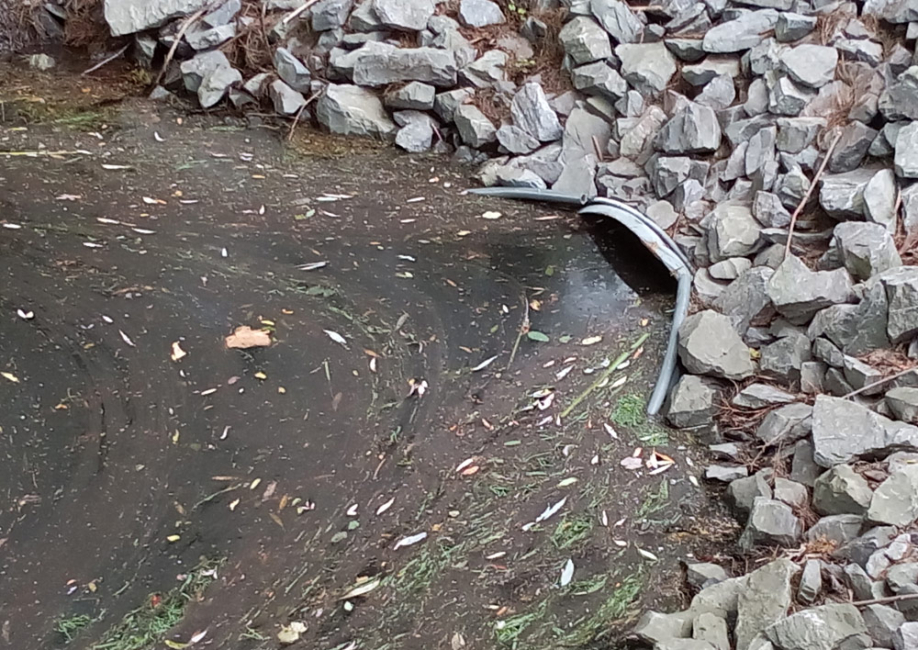
In stormwater management, some of the most serious failures begin as subtle warning signs that are easy to overlook unless someone is paying close attention. A cross culvert that appears nearly full on a dry day, with no recent rainfall to explain elevated water levels, is one of those warning signs. To an untrained eye, it may seem unremarkable. To an experienced foreperson or crew member, it is a red flag that demands immediate attention.
The photo above illustrates this perfectly. When the headwater depth at a culvert inlet approaches or exceeds three quarters of the culvert height under dry weather conditions, it strongly suggests a restriction or blockage within the system. In a properly functioning culvert, water levels should normalize relatively quickly after runoff events subside. When they do not, and downstream conditions appear normal, the logical conclusion is that flow is being impeded internally. In this case, the cause was beaver activity within the upstream pond, a common but often underestimated source of obstruction.
This kind of issue highlights an important truth about stormwater infrastructure, inspections alone are not enough. Formal inspection programs are essential and should be conducted on a regular schedule, but they are inherently periodic. Conditions in the field can change rapidly between inspections due to debris accumulation, sedimentation, structural failure, or wildlife activity. A culvert that passed inspection last month may be partially or fully obstructed today. That is where the daily presence of road crews becomes invaluable. Forepersons and crew members are uniquely positioned to act as the eyes and ears of a municipality’s drainage system. As they travel between job sites, perform maintenance, or respond to unrelated tasks, they are constantly passing by critical infrastructure. With a basic understanding of what “normal” looks like, they can quickly identify anomalies such as elevated water levels, unusual flow patterns, debris accumulation at inlets, or signs of erosion and instability.
Encouraging this kind of situational awareness transforms routine travel into an ongoing, informal inspection program. It does not require additional staffing or significant time investment, only a culture that values observation and reporting. When crews feel empowered to report concerns, even if they are uncertain, small issues can be investigated and addressed before they escalate into costly failures. In the case of a blocked culvert, early detection can prevent a range of serious consequences. These include upstream flooding, roadway overtopping, embankment saturation, and in extreme cases, roadway washouts or structural collapse. Beaver activity, in particular, can rapidly alter hydraulic conditions by introducing debris dams that restrict flow and raise upstream water levels. Left unaddressed, these conditions can worsen quickly and create hazardous situations for both infrastructure and the traveling public.
It is also important to reinforce that reporting a concern is not an admission of uncertainty, it is an act of professionalism. A crew member who notices something unusual and brings it to attention is contributing directly to the safety and resilience of the transportation system. In many cases, these observations are the first and only warning before a failure occurs. Municipalities can support this proactive approach by providing basic training on culvert behavior, including how to recognize abnormal headwater conditions, identify signs of blockage, and understand the potential causes. Simple guidelines, such as noting when water levels seem unusually high during dry weather, can go a long way in building confidence among crew members.
Ultimately, maintaining stormwater infrastructure is not just about scheduled inspections and engineered solutions. It is about awareness, experience, and communication. The vigilance of a knowledgeable crew member passing by a culvert on an ordinary day can prevent extraordinary damage.
The photo tells that story, a nearly full culvert on a dry day is not just an interesting observation, it is a warning. And thanks to someone paying attention, it became an opportunity to act before a small problem turned into a major failure.
***Note the brown film, grass clippings and fallen leaves on the water's surface. These are further signs that the stormwater flow had either stopped or the flow had decreased to a crawl. Fortunately, before the road was over-topped, a road maintenance crew was able to push a limbed tree through the culvert, clearing the blockage of branches, mud, and other debris the beavers had placed inside. (24 inch culvert - approximately 25 feet long)