

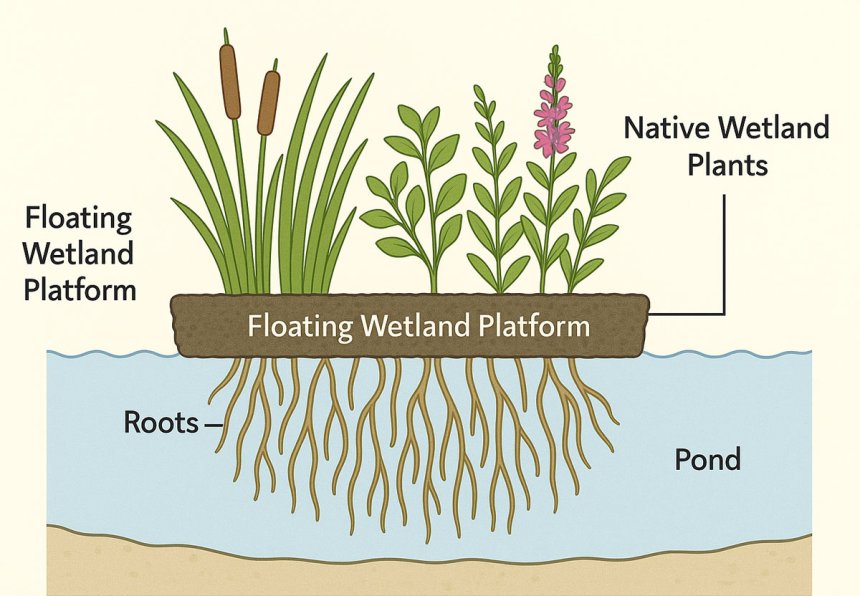
Floating wetlands are emerging as an innovative and increasingly popular tool for improving water quality in stormwater systems, ponds, and urban waterways. By replicating many of the functions of natural wetlands without requiring extensive excavation or shoreline restoration, these systems offer municipalities and property owners a flexible method of reducing pollutants, enhancing habitat, and improving the ecological health of managed water bodies.
Unlike traditional wetlands that rely on rooted vegetation growing in shallow soils, floating wetlands consist of buoyant platforms planted with native wetland species that float directly on the water's surface. The plants grow above the water while their root systems extend downward into the water column below, creating a dense network of suspended roots that acts as a living filtration system.
As stormwater flows through and around these root masses, sediments, nutrients, and other pollutants become trapped, absorbed, or transformed through biological processes. Nitrogen, phosphorus, suspended solids, and certain metals can all be reduced through the combined actions of plant uptake and microbial activity occurring on root surfaces. These processes help improve water quality while reducing the impacts of nutrient enrichment and eutrophication.
One of the most common applications for floating wetlands is within municipal stormwater ponds and detention basins. Many older stormwater facilities were originally designed primarily for flood control and peak flow reduction, with limited consideration given to water quality treatment. As a result, these basins often accumulate nutrients from fertilizers, roadway runoff, organic debris, and other urban sources, creating ideal conditions for nuisance algae growth and low dissolved oxygen levels.
Floating wetlands can transform these conventional stormwater basins into more biologically active treatment systems without requiring costly reconstruction or dredging projects. By increasing surface area for beneficial microbial communities and promoting nutrient uptake, floating wetlands help improve water clarity, reduce algal blooms, and support healthier aquatic ecosystems. They also provide an attractive visual enhancement to stormwater infrastructure that might otherwise appear purely utilitarian.
Placement within a stormwater pond can significantly influence performance. Floating wetlands are often installed near stormwater inlets where pollutant concentrations are highest or in areas where circulation patterns encourage water movement through the root zone. Strategic placement can maximize treatment efficiency while minimizing interference with pond maintenance activities and emergency overflow structures.
Beyond stormwater basins, floating wetlands are increasingly being used in municipal ponds, urban lakes, golf course water features, wastewater polishing lagoons, and recreational water bodies. In agricultural watersheds, they may be deployed in drainage channels or retention ponds to intercept nutrient-rich runoff before it reaches downstream streams, rivers, and lakes.
The ecological benefits extend well beyond water treatment. The submerged root systems create valuable habitat for aquatic insects, small fish, amphibians, and beneficial microorganisms. Fish often use the roots as cover from predators, while insects such as dragonflies utilize the vegetation for resting and breeding habitat. In urban environments where natural shoreline vegetation may be limited or absent, floating wetlands can restore some of the habitat complexity that has been lost through development.
Floating wetlands also offer advantages in water bodies that experience fluctuating water levels. Traditional shoreline plantings may struggle during drought conditions or become inundated during prolonged high-water events. Because floating wetlands rise and fall with changing water levels, plant roots remain within an optimal moisture zone regardless of seasonal fluctuations or storm events.
Installation requirements are generally modest compared to conventional wetland restoration projects. Most systems consist of modular floating mats constructed from recycled plastics or other durable materials and anchored in place using cables, posts, or weighted systems. This allows installations to be added to existing water bodies with minimal site disturbance and relatively few permitting challenges.
Maintenance requirements are similarly straightforward. Periodic inspections should evaluate plant health, anchoring systems, and structural integrity following severe weather events or ice movement. Excessive plant growth may occasionally require harvesting or trimming, which can provide the additional benefit of permanently removing nutrients that have been captured within plant tissues. Damaged sections of the floating platform can typically be repaired or replaced individually without affecting the entire installation.
Communities in northern climates should also consider winter conditions during system design and maintenance planning. Many floating wetland systems are designed to remain in place year-round and can tolerate ice cover and freeze-thaw cycles, while others may require seasonal removal depending on manufacturer recommendations and local conditions.
For communities facing harmful algal blooms, nutrient impairments, or water quality challenges within stormwater infrastructure, floating wetlands represent an attractive green infrastructure option. They require relatively little space, can often be retrofitted into existing facilities, and provide measurable environmental benefits without major capital construction projects.
As municipalities continue to seek cost-effective methods for improving stormwater treatment and meeting watershed protection goals, floating wetlands are likely to become an increasingly important component of modern stormwater management strategies. While they are not a replacement for source control or comprehensive watershed planning, they can serve as an effective supplemental treatment practice that enhances both the function and appearance of urban water resources.