

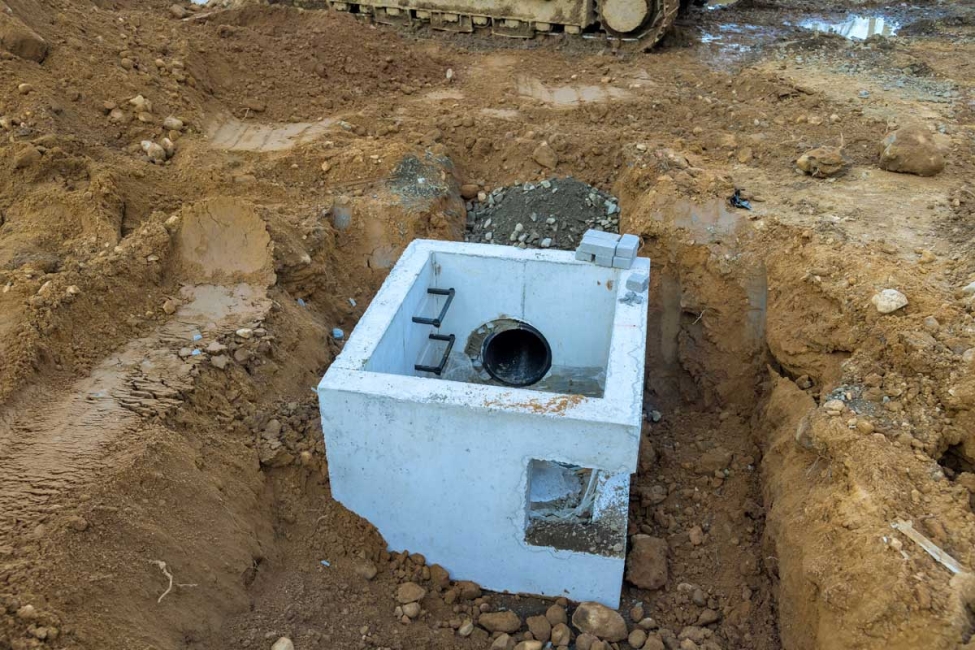
A precast vault is a large, reinforced-concrete box or cylinder installed below grade to detain, treat, or both detain and treat stormwater when surface land is scarce. The modules are factory-made for quality control, then craned into an excavated pit and connected to the storm drain network. (hamiltontn.gov, en.wikipedia.org)
Inlet pipe or curb opening brings runoff into a forebay or flow-spread chamber.
Internal baffles calm velocities and direct water downward into the deep sump.
Gravity does the work:
Dense particles drop to the sump floor.
Oils and trash rise and are trapped behind a hood or screen.
Mid-level outlet conveys clarified water to the downstream pipe or to a polishing filter bay, depending on the design. (mass.gov)
| Benefit | Physical Process | Result |
|---|---|---|
| Sediment capture | Velocity loss lets sand and fines settle on the sump floor | Lower Total Suspended Solids (TSS) at the outlet |
| Oil & grease removal | Buoyant pollutants rise and are blocked by a hooded baffle | Visible sheen and hydrocarbons are reduced |
| Floatables control | Screens or orifices keep litter in the vault | Trash-free receiving waters |
| Spill containment | Extra sump volume provides emergency storage | Small spills stay underground until vacuumed |
Field and regulatory data back up the effect:
Massachusetts credits a 25 % TSS reduction to deep-sump catch basins used as pretreatment. (readingma.gov)
EPA verification of a sump-and-cartridge vault showed 46 % TSS removal (92 % by SSC) during 15 storm events. (cfpub.epa.gov)
Sump depth: 3–4 ft below the lowest outlet elevation is common; deeper (>10 ft) only when maintenance crews have vacuum trucks rated for that lift. (stormwater.com)
Length-to-width ratio: 2:1 or higher promotes laminar flow and better settling.
Baffle height: Drop the baffle top at least 12 in below the outlet invert so floating oils cannot escape.
Bypass pipe: Provide a high-flow bypass to prevent scour of captured sediment during large storms.
| Task | Frequency | Notes |
|---|---|---|
| Measure sediment depth | Twice per year | Clean when ≥50 % of sump volume is filled. (megamanual.geosyntec.com) |
| Vacuum sediment & liquids | As needed (often yearly) | Use a Vactor-type truck; observe confined-space rules. (stormwaterpartners.com) |
| Inspect baffles, screens, and joints | Yearly | Repair cracks or corrosion to maintain water-tightness. |
Skipping maintenance not only kills performance, it can turn the vault into a pollutant source if stored material goes anaerobic.
Ideal for
Dense commercial sites, parking structures, and retrofits with no room for surface BMPs.
Pretreatment for infiltration chambers or media filters, extending their service life.
Limitations
High capital cost per cubic foot of storage.
Confined-space entry requirements add to O&M budgets.
Limited nutrient removal without supplemental filtration or media. (environment.fhwa.dot.gov)
Precast underground vaults offer a compact, factory-controlled solution for both quantity and quality control.
Their deep sump leverages simple gravity to drop out grit, capture oils, and hold spills, leading to outfall water that is measurably cleaner than the inflow. With proper sizing and routine vacuum maintenance, a vault can provide decades of reliable service, all while staying hidden beneath the pavement.